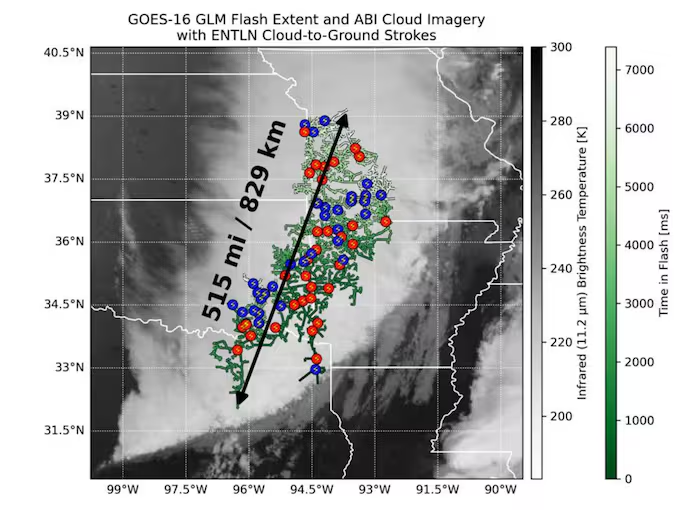

The lightning strike, which occurred over the southern U.S. in 2017, was found in a reanalysis of satellite and lightning data.
The bolt emerged from a large thunderstorm complex, known as a mesoscale convective system, that spanned from near Dallas to just east of Kansas City, Missouri. Simultaneously, parts of Texas, eastern Oklahoma, northwest Arkansas, southeast Kansas and southwest Missouri were all illuminated by its flash.
In fact, an area of land five times greater than the size of Massachusetts was lit up by the overhead flash. The record eclipses a 477.2 mile-long bolt that discharged across parts of the southern Plains on April 29, 2020.
“These new findings highlight important public safety concerns about electrified clouds which can produce flashes which travel extremely large distances and have a major impact on the aviation sector and can spark wildfires,” Celeste Saulo, the secretary general for the World Meteorological Organization, said in a statement about the discovery.
Lightning specialists are calling the episode a “megaflash,” noted for its exceptional duration and size. They can occur in sprawling storm clusters and complexes that have horizontally expansive areas of electric charge.

Most thunderstorms are fewer than 10 miles tall, so to get a megaflash, you’d need a long or wide thunderstorm complex.
The WMO’s committee on weather and climate extremes used data from the GOES 16, 17, 18 and 19 satellites, positioned some 22,236 miles above Earth’s surface, to map the origin of the flash. Each satellite has the ability to sense lightning discharges from above, even if they don’t strike the ground.
That data was then merged with ground-based lightning strike data from the Earth Networks Total Lightning Network. It was found that the same ultra-expansive flash also produced 64 bolts that struck the ground.
“The extremes of what lightning is capable of is difficult to study because it pushes the boundaries of what we can practically observe,” said evaluation committee member Michael J. Peterson, a researcher at the Georgia Tech. Adding observations from satellites was the final piece of the puzzle, he noted.
Megaflashes are also known to be long in duration. On June 18, 2020, an enormous bolt spent a total of 17.1 seconds discharging over Uruguay and northern Argentina.
“The duration of this flash was over 7 seconds,” Randy Cerveny, a researcher and professor at Arizona State, said in an email.
Megaflash research helps scientists understand how geographically expansive lightning hazards can be, particularly since flashes can evidently travel far distances from the initial region in the cloud containing charge. Scientists have coined a term — “bolt from the gray.”
“This type of lightning event, a mega flash, typifies the kind of flash that appears to come from ‘clear skies,’” Cerveny added. But, as with all lightning, it “actually does come from a thunderstorm … from a very great distance. These mega flashes can travel immense distances from their origin point.”
In its new announcement, the WMO also referenced two other lightning records — both for fatality counts from single strikes. In 1975, 21 people in Zimbabwe were killed by a bolt as they huddled inside a hut for safety. And in 1994, 469 people were killed in Dronka, Egypt when lighting struck a set of oil tanks, sparking a fire and causing burning oil to flood the town.