
During the making of Man of La Mancha (1972), Sophia Loren once again demonstrated why she was regarded as one of the most iconic and enduring stars of classic cinema. By this point in her career, Loren had already achieved international fame, earned an Academy Award, and established herself not only as one of the most beautiful women in the world but also as an actress of rare depth and emotional honesty. Yet her decision to take on the role of Aldonza in the film adaptation of the acclaimed Broadway musical was another bold step forward, pushing her into a realm of raw vulnerability and dramatic intensity that left an indelible mark on her legacy.

The film itself was ambitious. Adapted from the beloved stage production, Man of La Mancha drew inspiration from Miguel de Cervantes’ timeless novel Don Quixote, weaving together themes of idealism, illusion, and redemption. At its heart was the story of an aging knight who sees the world not as it is, but as it should be — and his devotion to a woman whom he insists on calling “Dulcinea.” That woman, Aldonza, is no noble lady but a weary, hardened barmaid whose life has been shaped by abuse, exploitation, and disappointment. To inhabit this character required an actress who could balance grit with grace, cynicism with yearning — and Sophia Loren rose to the challenge with characteristic courage.
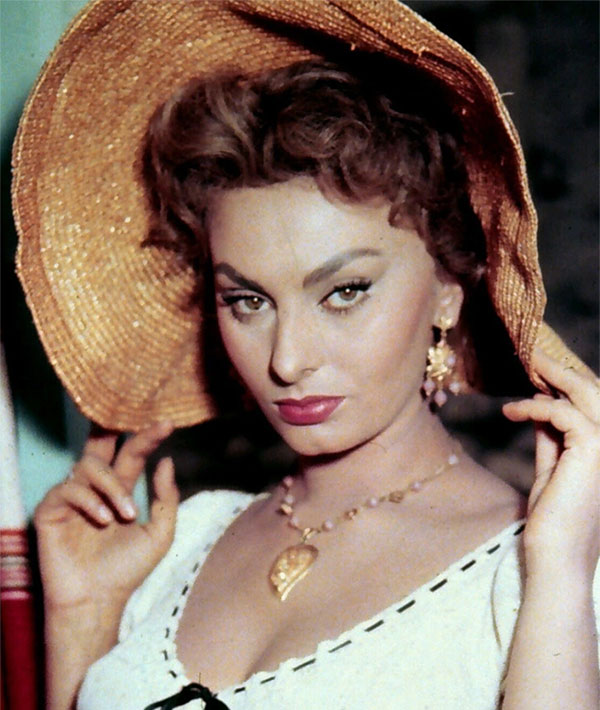
On the surface, Loren seemed an unlikely Aldonza. Known worldwide for her dazzling beauty, magnetic screen presence, and sophisticated glamour, she might have appeared too refined for such a rough-edged role. But Loren’s brilliance lay in her ability to transcend typecasting. From her earliest performances in Italian neorealist films to her Oscar-winning role in Two Women (1960), she had shown a willingness to strip away vanity in pursuit of truth. In Man of La Mancha, she embraced Aldonza’s rawness wholeheartedly. Her portrayal captured the character’s hardened exterior — the defensive sharpness of a woman who has learned to survive in a cruel world — while also revealing the fragile humanity beneath.
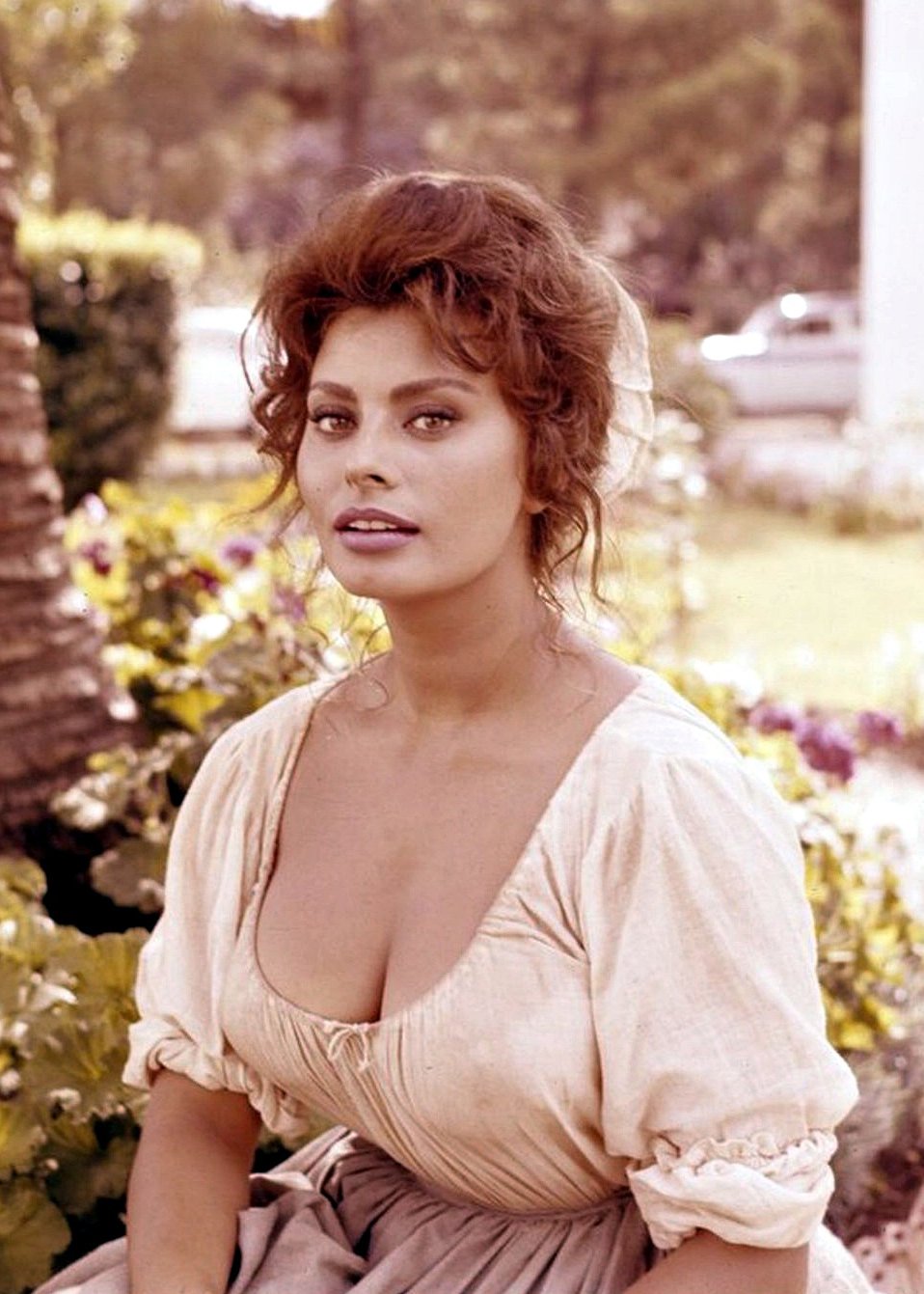
The production itself was not without challenges. Filming on location brought grueling conditions, with long shooting days under harsh weather and a script that demanded both physical stamina and emotional intensity. Director Arthur Hiller struggled at times to balance the theatrical grandeur of the musical with the demands of cinematic realism, and creative disagreements occasionally cast shadows over the project. Yet through all this, Loren’s professionalism never wavered. Co-stars and crew alike recalled her poise, discipline, and the magnetic presence she carried both on and off set. While her fame naturally drew attention, it was her commitment to the role — her willingness to inhabit Aldonza fully — that anchored the production.
Working opposite Peter O’Toole, who played Don Quixote, Loren created moments of unforgettable chemistry. Their scenes together underscored the central tension of the story: his unwavering idealism colliding with her world-weary pragmatism. The poignancy lay in the transformation Aldonza undergoes — slowly, almost reluctantly, beginning to see herself through Quixote’s eyes, not as a broken woman but as someone worthy of dignity and love. Loren’s ability to convey this gradual shift, through subtle changes in body language, tone, and expression, added layers of emotional resonance to the film.
.jpg)
Though the film itself received mixed reviews upon its release, with some critics questioning its translation from stage to screen, Loren’s performance was consistently singled out for praise. She was lauded for bringing sincerity, vulnerability, and fire to a role that could easily have been reduced to stereotype. Even those who felt the film faltered recognized that Loren’s Aldonza was a triumph of characterization — at once fierce and tender, bruised yet resilient.
For Loren personally, Man of La Mancha was more than just another credit in a glittering filmography. It represented her ongoing willingness to tackle roles that defied easy categorization. She was not content to rest on her beauty or her established screen persona; instead, she sought projects that tested her emotional range and artistic stamina. In Aldonza, she found a character who embodied contradiction — toughness masking vulnerability, cynicism giving way to hope — and she brought her to life with conviction.
May you like


Looking back, the film has endured less as a mainstream success than as a cult favorite, but Loren’s work within it has only grown in appreciation. Today, it is remembered not just as an ambitious adaptation of a classic tale but as a showcase for one of cinema’s most gifted actresses at the height of her powers.
Decades later, Sophia Loren’s Aldonza remains a reminder of her artistry. She was more than a glamorous star; she was a performer unafraid to get her hands dirty, to strip away artifice, and to reveal the emotional scars of her characters. Man of La Mancha may not stand among her most famous films, but it highlights the very qualities that made Loren a legend: her resilience, her courage, her ability to merge elegance with emotional depth, and her refusal to be confined to the role of mere screen siren.
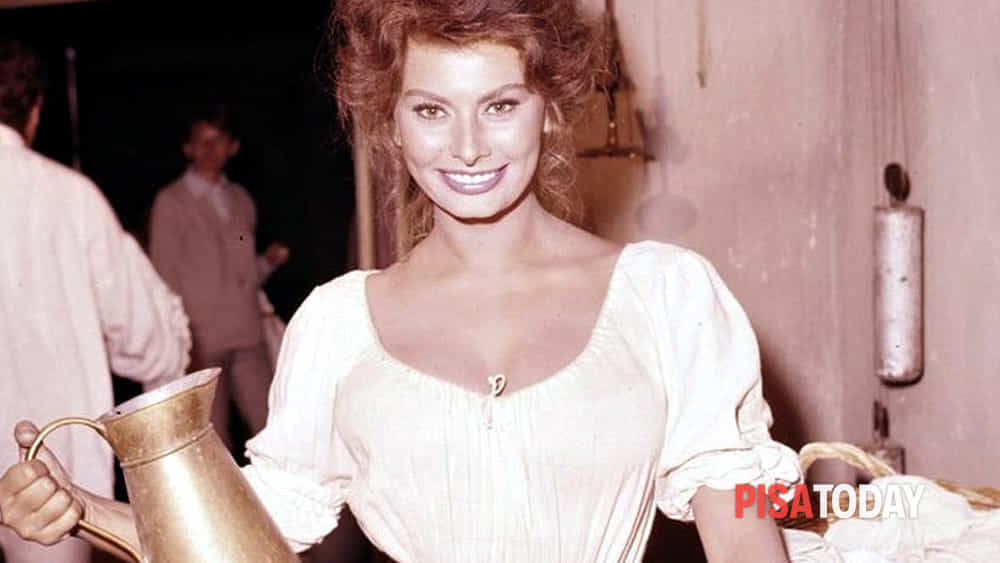
In a role that demanded toughness, vulnerability, and transformation, Sophia Loren proved once again that she belonged to a rare class of performers — those who transcend time. Even now, her Aldonza speaks to audiences not just as a character in a story, but as a mirror of human strength and fragility. And in doing so, Loren further solidified her place among the greatest actresses the cinema has ever known.
Long before she was Hollywood’s icy goddess, Gene Tierney starred in a film few remember—but it might be her most daring performance yet

When people think of Gene Tierney, the immediate images that come to mind are her unforgettable turns in Laura (1944) or Leave Her to Heaven (1945). These films immortalized her as one of Hollywood’s most luminous stars, an actress of striking beauty and enigmatic sophistication. Yet, before she stepped into the noir shadows of Laura or embodied the dangerous allure of Ellen Berent, Tierney’s career took her to a far more unexpected place: the deserts of British East Africa in Sundown (1941).
At just twenty-one years old, Tierney was still carving out her place in an industry that often typecast ingénues into glamorous but limited roles. For a rising actress of her age and appearance, audiences might have expected cocktail dresses, satin gowns, or the polished drawing rooms of a studio melodrama. Instead, under the direction of Henry Hathaway, she donned khaki fatigues and weathered the scorching desert sun in a wartime adventure film set against the backdrop of global turmoil. It was an unconventional role, a daring choice for someone so new to the screen, but one that gave an early glimpse of the talent and range that would later define her career.
In Sundown, Tierney portrayed Zia, a woman of mysterious heritage who becomes entangled in espionage and political intrigue during the Second World War. Unlike the decorative roles so often given to actresses early in their careers, Zia demanded a certain gravitas. She was enigmatic, self-possessed, and deeply layered—simultaneously alluring and inscrutable. Tierney brought to the character a unique mixture of strength and vulnerability, grounding Zia with quiet authority while allowing glimpses of the loneliness and burden she carried. The performance required her to move beyond beauty alone, to create a character whose strength was as compelling as her mystery.
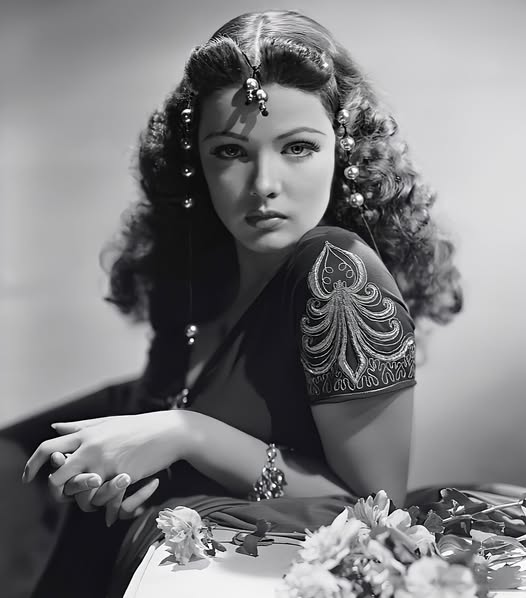
For audiences at the time, seeing Tierney in dusty desert gear instead of glittering gowns was itself a surprise. Yet this setting allowed her natural beauty to emerge in an entirely different way—less polished, more organic, and undeniably magnetic. In her stillness, her measured delivery, and her commanding presence, Tierney hinted at the kind of dramatic intensity that would later astonish audiences in more celebrated works. Even in this early role, she demonstrated an instinctive understanding of how to make restraint feel as powerful as grandeur.
Sundown itself was very much a product of its historical moment. Released in 1941, before the United States formally entered World War II, it carried the marks of both adventure cinema and wartime propaganda. The film was filled with exotic landscapes, tense battles, and anti-fascist messaging designed to resonate with contemporary anxieties. It was nominated for three Academy Awards, including Best Cinematography and Best Art Direction, praised for its sweeping visuals and atmosphere. Yet despite these accolades, the film did not maintain the same cultural longevity as other wartime dramas. Its dated depictions of Africa and its propagandistic overtones have caused it to fade from prominence in the decades since.

But what has endured is Tierney’s performance. For her, Sundown was more than a film; it was a proving ground. It gave her a chance to display emotional depth in a role that resisted the conventions of ornamental starlet parts. Where many young actresses of her era might have been sidelined into smiling ingénues, Tierney carved out something different—something with substance.
This early choice in her career proved telling. Just a few years later, she would give life to one of cinema’s most haunting images in Laura, where her character exists simultaneously as an idealized portrait and a flesh-and-blood woman. In Leave Her to Heaven, her performance as the obsessive and chilling Ellen Berent was so powerful that it earned her an Academy Award nomination. These roles revealed her ability to embody contradictions—cool yet passionate, fragile yet unyielding, ethereal yet grounded. And the seed of that artistry can be traced back to films like Sundown, where she first displayed her ability to transcend surface expectations.

The legacy of Sundown is not simply as a wartime curiosity, but as an early step in the evolution of an actress who would leave an indelible mark on Hollywood. In revisiting it, one doesn’t just see an adventure tale set against desert sands. One sees the outline of a star beginning to emerge, a performer whose subtlety and presence hinted at the iconic career yet to come.
Today, Gene Tierney’s name evokes an almost mythical image of classic Hollywood beauty—an actress who seemed both untouchable and deeply human. Yet her legacy rests not only on her appearance, but on her extraordinary ability to infuse characters with quiet power and emotional depth. Sundown may not rank among her most famous works, but it remains essential for understanding the trajectory of her career. It showed that even at twenty-one, long before the world would know her as Laura, Tierney possessed the resilience, intelligence, and artistry to rise above the constraints of the studio system.

In the blazing sun of an African desert set, Gene Tierney proved she could shine as brightly as she would under the elegant chandeliers of noir classics. And though Sundown has been overshadowed by the films that followed, it stands as an important reminder: the brilliance of Gene Tierney was evident from the very beginning.
